 (source)
Is there a difference in the way the brain takes in or absorbs information when it is presented electronically versus on paper? Does the reading experience change, from retention to comprehension, depending on the medium?
 "No one would have believed in the last years of the nineteenth century that this world was being watched keenly and closely by intelligences great than man's," begins H. G. Wells' classic, The War of the Worlds. Since the book first came into my hands in Junior High, it has been the bane of my existence. I could not - or that would not - complete the book due to the manner in which it was written. Classic literature always had - and still has - that effect on me. The dull prose and lengthy narrative that seems to be ongoing. Shame on me, I'm an English major.
 They were found dead amongst their collected junk - bales of newspapers, crates, bicycles, worn clothing and guns, to name of few - the Collyer brothers are iconic American pack rats that spark imagination within us. What went on behind those shuttered windows, the booby traps and bolted doors? What lives did these living ghosts live? What drove them to collect articles of junk to store in their homes?
Both novels make a reader ache for a city long gone. But they also let us know that the end of the world as we know it may only be the end of the world as we know it. What's truly scary is not that life will end but that it will continue in ever reduced circumstances.

 In other news, because I arrived early to the library, I camped in a corner (where the DVDs are - why there's a couch where the DVDs are is beyond me) and thumbed through Homer & Langley by E.L. Doctorow. A few pages in, I decided to check it out.
"Can We Stop Acting So Childish?" By Stephen Marche
With teenage celebrities entering rehab and adult celebrities acting like teenagers, the line between adolescence and adulthood has never been more blurred.
It is possible that as you read these words one of the great works of art of our time is being destroyed. The film version of "Where the Wild Things Are"--with a screenplay cowritten by the Coolest Writer in America (Dave Eggers), directed by the Coolest Director Alive (Spike Jonze), and starring the Coolest Actors Ever (Forest Whitaker and Catherine Keener)--has had its release date set back a year, apparently after disastrous test screenings, to undergo massive reshooting. The original "Where the Wild Things Are," the children's story by Maurice Sendak, is one of the most beloved tellings of one of the dominant narratives of our era: the child who suffers the perils of adulthood. It's a story that has to be told without wavering. (continue reading)
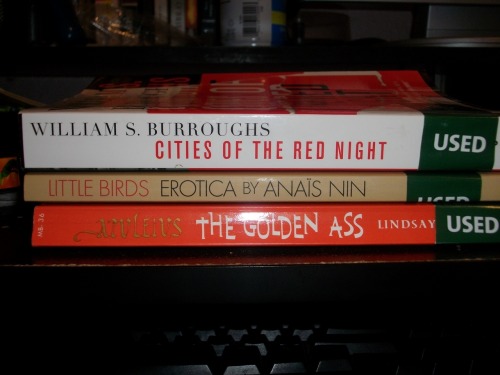
After ringing up the purchase, The Golden Ass turned out to be my dollar book. I also saw a copy of God Hates Us All, leaving me to wonder if a fictional book from a TV series is actually worth the read. Who am I kidding? Sooner or later Hank Moody's opus will be sitting on my shelf because I'm in love with Californication.

Across much of the nation and the world, people have been losing their jobs and homes due to the global economic decline. Everyone is asking: how much worse will it get; how soon before it gets better? The ghost of the Great Depression hangs over us like a bad dream that scares and fascinates at the same time. Meanwhile, the bickering of politicians entertains and annoys us nightly.
 Forgive the mess and my excess use of my newly purchased digital camera, with which I'm in love. I decided to shed some light in to my personality by showing you which books are on my desk at the moment. They are:
 I'm with you on this one, Chuck. When it comes to adaptations I used to be like most of you who complained how it wasn't faithful to the novel or short story or graphic novel or whatever creative medium it spawned from. However, after years of reading books and watching movies - especially the adaptations of said books - I've come to realize that movies should offer something new, a stand alone.
 The actors were stellar with the parts given; it was the storyline that nearly left me upset. There was no way that the novel was taken a part so horribly and stapled back together like this piece of shit movie. But that's the old me talking. The me who used to hate going to the movies only to watch one of his favorite books ripped asunder. What have I learned after all these years? Film adaptations shouldn't be compared to the book, regardless.


